|
|
|
Racing blind allowed me to feel more.
|
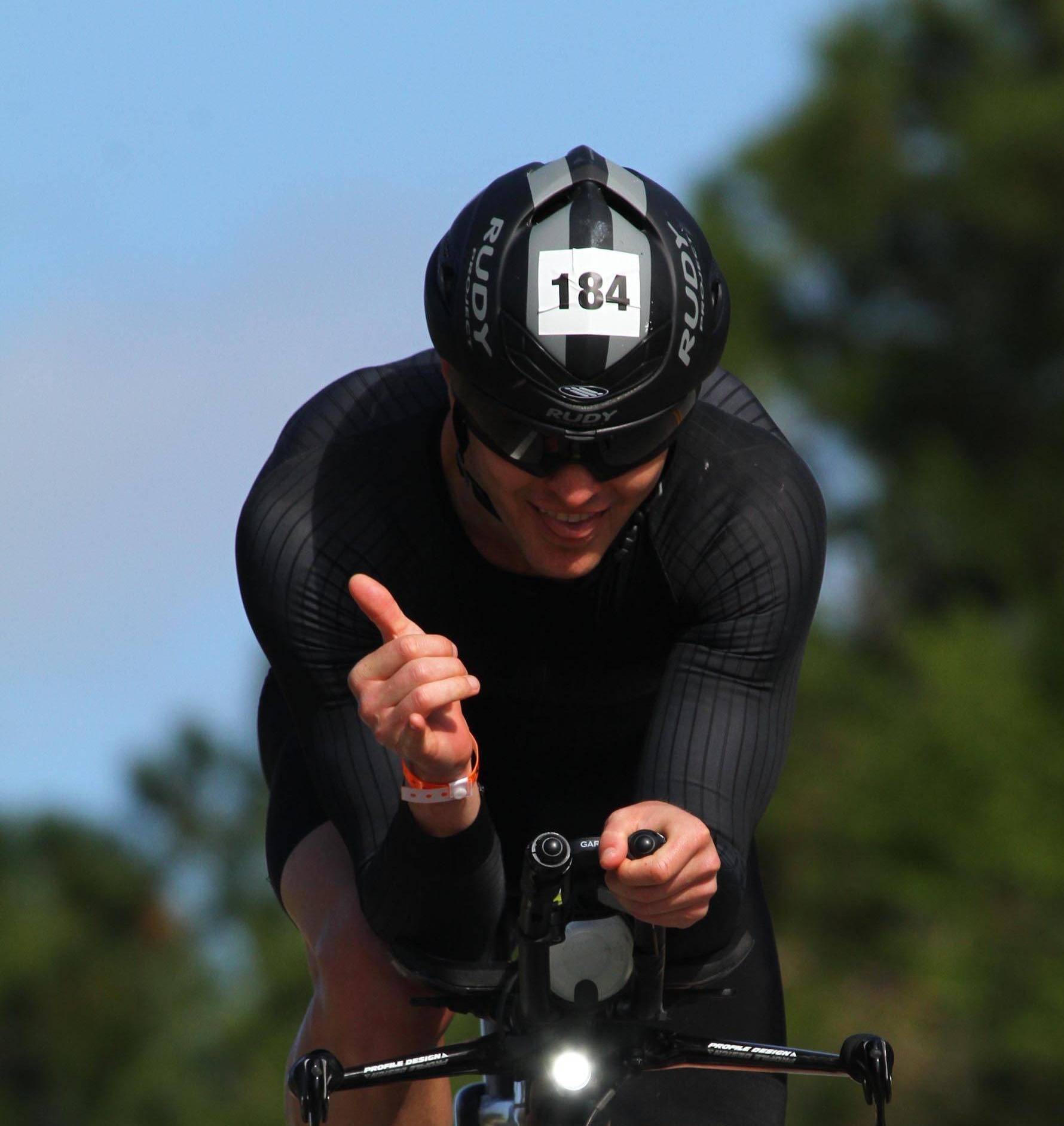
Somewhere in the first hour of the Day 1 bike at Ultraman Florida 2020, I caught myself doing something stupid.
I was tired from the 10k swim, my whole body was tired and I was staring at my bike computer, obsessing on the power. Chasing a predetermined target I’d practiced over and over in training (225W). Every time it dipped below target, I pushed, and every time it crept high, I backed off. I was riding the 91 mile bike like it was a test.
In Ultraman’s, if there’s one thing I feel the most confident in, it’s riding my bike. I’ve spent countless hours building the engine and learning what a sustainable effort feels like in my legs, my lungs, my gut. But in that moment, all of that confidence didn’t matter, because my attention was locked on a single number on a screen.
And no matter how much I focused on that number, it just kept feeling harder and harder. So in that moment, as I kept getting more frustrated with the fatigue I made a decision. I changed the screen to my map only. No power, no speed, no heart rate. I just settled on turn-by-turn navigation and my varia radar to let me know when a car was coming from behind.
That ride ended up being the 2nd fastest UMFL Day 1 bike split ever. The next day I went straight to the map screen. The result, 240W for 7 hours and 46 minutes. The fastest Day 2 bike split to date at UMFL. (Jeff Fejfar has since beat this) More than 25W higher than I had intended on riding for that day and I rode the entire thing by feel. Racing blind allowed me to feel more.
Don’t get me wrong, I’m a nerd when it comes to using data and metrics in training. I prescribe athlete workouts with power targets. I review files, calculate zones, and measure improvements.
But data is only one input. And when it comes to racing, we’re working on a multi-variable problem.
When you’re deep into a race, you’re managing fatigue that’s building in real time. Heat that’s changing by the hour. A course profile that rolls, climbs, and descends. Technical terrain that demands more focus in some sections than others. Nutrition, hydration, mood, or the athletes around you.
Your power meter or watch knows none of that. It knows watts and pace.
When you lock your attention onto the number, you’re not just focusing on one thing. You’re actively pulling awareness away from everything else. The tightness creeping into your hip. The fact that you haven’t taken a gel in 40 minutes. The descent coming up where you could recover for free.
Focusing on just that one number makes you narrow onto one input. But when you’re racing you have to have the ability to expand.
But there is a catch. You can’t just turn off the computer on race day and hope for the best. Riding or running by feel only works if you’ve trained the feel.
This is where training comes in, and it’s why I coach effort the way I do.
When I prescribe workouts for my athletes, I rarely stop at a pace or power target. I attach a cue. Something like:
- “At this effort, if I asked you how your day was going, you should be able to answer in a full sentence”.
- “At this effort, you get two or three words at a time, max”.
- “Could you sing an entire lyric to the music you’re listening to right now? Then you’re at your easy aerobic effort.”
- “Speaking in short phrases or sentences? That’s the threshold effort we’re going after.”
These cues do something the numbers can’t. They teach you what the effort feels like from the inside. Do this over hundreds of sessions and you build a vocabulary of effort. You know what “moderate” feels like in your body the same way you know your own signature.
The pros do this too. Brett Sutton, one of the most successful coaches in triathlon history, famously prescribes intensity in plain language. Medium. Moderate. Mad. Not 240 watts. Not 4:05 per kilometer. His athletes learn the efforts by feel, over and over, until the effort itself is the target.
Recently, one of Sutton’s athletes, Alanis Siffert, won Challenge Roth. She had the fastest bike split of the day, followed by a 2:45 marathon. She beat Lucy Charles-Barclay by more than seven minutes and became the youngest winner of that race in 40 years.
Here’s the part that makes this story a valuable lesson. On the bike, riding herself into the lead, she glanced at her power and saw numbers higher than anything she’d ever sustained. Most athletes would have panicked and backed off. The number says slow down, so you slow down.
Siffert covered the numbers on her bike computer. She stopped looking at her run pace too. She’d trained those efforts a thousand times. She knew what her sustainable hard felt like, and on that day, her body was telling her it had more. So she trusted the feel and committed.
The data would have talked her out of the race of her life.
I see this with my own athletes all the time, usually by accident. A power meter dies mid-ride. A watch won’t sync. Or someone deliberately flips their computer over and rides blind.
And almost every time, the same report comes back: that felt great. Sometimes it’s their best session in weeks. Without the number to argue with, they stop negotiating and just execute the effort they already know how to produce.
This matters even more for ultrarunners. Your races aren’t flat time trials. They’re climbs where pace means nothing, descents where the effort is in your quads and your focus, technical sections that demand your eyes on the trail and not your wrist. And late in a 100 miler, your pace might be slower than your easiest training run while your actual exertion is near the limit. The data is masking your real sensations.
There’s a name for what’s really happening here, and it’s a mindset concept worth knowing: control what you can control.
When your attention lives on the data, you’re anchored to outcomes. Hitting a number. Holding a pace. Those things are influenced by heat, terrain, fatigue, and a half a dozen factors that you can’t control. Chasing them mid-race is chasing something partly outside your control, and that’s where anxiety, doubt or frustration build.
When you race by feel, your attention shifts to the things you can actually manage in the moment. Your effort. Your breathing. Your fueling. Your focus on the trail in front of you. That’s how you regain confidence when doubt or frustration starts to creep in.
The data helps build the athlete in training. The self awareness is what guides the best athletes in races.
Here’s the practical takeaway, and you can start this week:
Build your own cue system for the intensities you train at. It doesn’t have to match anyone else’s. Maybe your easy effort is “could sing a song.” Maybe your moderate effort is “full sentences, but I wouldn’t want to.” Maybe your hard effort is a specific breathing rhythm, or the point where your focus narrows to ten feet of trail.
Then practice noticing. On your next few workouts, guess your effort before you look at the watch. Check yourself. Over time, the gap between what you feel and what the data says will shrink. That’s how you mold the language of your internal voice.
Because on race day, when it matters most, the athletes who excel aren’t the ones with the best data. They’re the ones who know exactly what the effort should feel like, and trust it. Sometimes all you have to do is change the screen.
Happy Training!
Interested in coaching? Schedule a call.